
Earth's Interior & Plate Tectonics
What is this concept, and why does it matter?
The Earth is made of three main layers — the crust (thin outer layer we live on), the mantle (thick, hot middle layer), and the core (hot, heavy centre of iron and nickel). The rigid crust plus the upper mantle forms the lithosphere, which is broken into moving tectonic plates.
The Earth's surface is not fixed — mountains, oceans, earthquakes, and volcanoes all exist because the plates move. The theory of plate tectonics (given by W. J. Morgan) explains how and why these large pieces of the crust shift over time.
Heat from the core makes molten material in the mantle rise, cool, and sink, creating convection currents. These currents drag the plates resting on the semi-molten asthenosphere, moving them a few centimetres each year — about as fast as your fingernails grow.
Where plates meet (plate boundaries), their movement builds and breaks the surface: convergent boundaries raise fold mountains like the Himalaya, divergent boundaries create new crust at mid-ocean ridges, and transform boundaries trigger earthquakes. Most of these events ring the Pacific in the 'Ring of Fire'.
Singhbhum Craton — One of Earth's Oldest Landmasses
The Singhbhum Craton in Jharkhand contains some of the earliest known continental crust on Earth — rock that emerged above the ancient oceans billions of years ago. It is a living window into how the first stable landmasses and the lithosphere formed.
Varāhamihira and 'Bhukampa' (the Shaking of the Earth)
Centuries before modern seismology, the scholar Varāhamihira dedicated a section of his Bṛhat Saṁhitā to earthquakes, noting how changes in wind, clouds, animal behaviour, and the sky might signal them — an early attempt to read the warning signs of the restless Earth.
The Deccan Traps — Fissure Volcanism that Shaped a Region
Vast layers of solidified lava across Maharashtra's Deccan Plateau formed from repeated eruptions of runny lava through long cracks in the ground. They show how internal (endogenic) volcanic forces can reshape the surface and, after weathering, even create fertile black soil.
Key terms and formulas
The rigid outer shell of the Earth made of the crust and the upper part of the mantle; it is broken into tectonic plates.
Asthenosphere (the soft layer below it)
The semi-molten, partly fluid layer of the upper mantle on which the tectonic plates float and move.
Lithosphere (the rigid layer above)
A massive slab of solid rock (part of the lithosphere) that moves slowly over the asthenosphere. Types: continental, oceanic, and mixed.
Continent (a landmass, not the whole plate)
The circular movement of mantle material caused by heat from the core — hot material rises, cooler material sinks — which drives plate movement.
Ocean current (movement of seawater)
The edge where two plates meet. Three types: convergent (move together), divergent (move apart), and transform (slide past).
Coastline (edge of land and sea)
The belt of active plate boundaries around the Pacific Ocean where most of the world's earthquakes and volcanoes occur.
Mid-Atlantic Ridge (a single divergent feature)
Think It Through
Peel back the layers of the Earth — crust, mantle, outer and inner core — and see where the lithosphere and asthenosphere sit.
Why the Himalaya is Still Rising
- The Himalaya lies where the Indo-Australian Plate meets the Eurasian Plate.
- Both plates carry continents, so neither sinks — this is a convergent (collision) boundary.
- The collision squeezes and folds the rocks upward into fold mountains.
- The Indo-Australian Plate keeps pushing north by a few cm/year, so the folding — and the uplift — continues today.
Reading the Three Boundaries
- Convergent = together, divergent = apart, transform = sliding past.
- Together → collision → fold mountains; apart → magma rises → new crust → ridge; sliding → friction → earthquakes.
- (i) convergent, (ii) divergent, (iii) transform.
Real-world case studies
The Himalayan Collision and the Gangetic Plain
- Which type of plate boundary created the Himalaya?
- How is the fertile Gangetic Plain geologically connected to the rise of the Himalaya?
- Why does this region also experience frequent earthquakes?
Koti Banal — Building for a Shaking Earth
- Why is Uttarakhand so prone to earthquakes (link to plate tectonics)?
- How does a flexible structure help a building survive an earthquake?
- What does Koti Banal tell us about how communities adapt to the Earth's internal forces?
Exam-ready recap
Focus Areas
The lithosphere is the rigid plate; the asthenosphere is the soft layer it floats on. Mixing these up is a very common error.
Always pair each boundary with its movement AND an example: convergent–Himalaya, divergent–Mid-Atlantic Ridge, transform–San Andreas Fault.
They are not random — they line up along plate boundaries, best seen in the Ring of Fire.
Common Mistakes
✓ The crust is the THINNEST layer; the mantle is the thickest (about 2,900 km).
✓ New crust forms at DIVERGENT boundaries (plates moving apart). At convergent boundaries, crust is destroyed or folded.
✓ This textbook credits the theory of plate tectonics to W. J. Morgan.
Data Sheet
Exam Tips
- When naming a plate boundary, always state the movement (together/apart/past) and give one example.
- If a question mentions the Himalaya, think 'convergent boundary, Indo-Australian + Eurasian plates'.
- Link the Ring of Fire to plate boundaries — never describe it as a random cluster.
Every Question Type — Sampled
These are samples from our full question bank for this lesson. Subscribe for complete access to every question, every type, every chapter.
MCQ
2 samplesClick an option to check your answer and see why.
Click an option to check your answer and see why.
Assertion-Reasoning
2 samplesReason (R): The Indo-Australian Plate continues to move northward and push against the Eurasian Plate.
Click an option to check your answer and see why.
Reason (R): The lithosphere rests on the semi-molten asthenosphere, which allows the plates to move.
Click an option to check your answer and see why.
Chronology
1 sampleClick an option to check your answer.
Competency-Based
2 samplesA student overlays two world maps — one showing the boundaries of the major tectonic plates, and another showing the locations of the world's earthquakes and volcanoes. She notices that the dots marking earthquakes and volcanoes form long, narrow belts rather than being spread evenly, and that a large number of them ring the Pacific Ocean.
(a) What relationship between plate boundaries and the distribution of earthquakes and volcanoes can the student conclude?
(b) Name the Pacific belt she has observed and explain why so many earthquakes and volcanoes occur there.
(c) India's Himalayan region is one such belt. Using plate tectonics, explain why.
(b) The Pacific belt is the Ring of Fire. Many plates meet around the Pacific Ocean, and the constant movement and collision of these plates releases energy as earthquakes and allows magma to rise as volcanoes, so a large share of the world's earthquakes and volcanoes occur there.
(c) The Himalayan region lies on a convergent boundary where the Indo-Australian Plate pushes against the Eurasian Plate. The continuous build-up and sudden release of stress along this collision zone causes frequent earthquakes, making it one of India's most active seismic belts.
Large parts of the Deccan Plateau in Maharashtra are covered by thick layers of solidified lava called the Deccan Traps. These were formed long ago by repeated eruptions in which runny lava flowed out of long cracks in the ground, spreading over vast areas. Over time, the weathering of this lava produced the deep, dark, fertile 'black soil' of the region, which is excellent for growing cotton.
(a) What kind of internal (endogenic) force created the Deccan Traps?
(b) Explain how a landform created by internal forces later became useful to farmers through an external (exogenic) process.
(c) Why might huge volcanic eruptions like these also affect the atmosphere and life on Earth?
(b) Volcanism first built thick layers of solidified lava. Later, the external process of weathering slowly broke down this lava to form the deep, fertile black soil. So an internal force created the rock, and an external process turned it into soil that is excellent for farming, especially cotton.
(c) Huge eruptions release large amounts of ash and gases into the air. These can block sunlight, change temperatures, and pollute the air, affecting the atmosphere, climate, and living things over wide areas — which is why such large-scale volcanism is linked to major environmental change in Earth's past.
Long Answer
2 samplesAt a convergent boundary, plates move towards each other: continental collision forms fold mountains such as the Himalaya, while an oceanic plate sinking beneath a continental plate causes volcanoes and earthquakes. At a divergent boundary, plates move apart and magma rises to form new crust, creating mid-ocean ridges like the Mid-Atlantic Ridge. At a transform boundary, plates slide past each other without creating or destroying crust, mainly causing earthquakes, as along the San Andreas Fault in the USA.
Because earthquakes and volcanoes occur mainly along these boundaries, they are concentrated in belts such as the Ring of Fire around the Pacific Ocean. This shows that the theory of plate tectonics successfully explains the distribution of earthquakes and volcanoes across the Earth.
The crust together with the upper part of the mantle forms the rigid lithosphere, which is broken into tectonic plates. Beneath the lithosphere lies the semi-molten asthenosphere, which is soft enough to let the plates above it move. Heat from the core makes mantle material rise, cool, and sink, setting up convection currents.
Putting these together explains plate movement: the rigid plates of the lithosphere rest on the asthenosphere, and the convection currents flowing beneath drag and push them, so the plates move slowly, a few centimetres per year. This movement gives rise to mountains, ocean basins, earthquakes, and volcanoes, and explains how continents and oceans are distributed across the Earth.
Matching
2 samples| Column A | Choose the correct match from Column B |
|---|---|
| Convergent boundary | |
| Divergent boundary | |
| Transform boundary | |
| Ring of Fire |
Convergent boundaries (collision) form fold mountains like the Himalaya. Divergent boundaries form mid-ocean ridges like the Mid-Atlantic Ridge. Transform boundaries like the San Andreas Fault cause earthquakes. The Ring of Fire is the Pacific belt of earthquakes and volcanoes.
| Column A | Choose the correct match from Column B |
|---|---|
| Crust | |
| Asthenosphere | |
| Outer core | |
| Inner core |
The crust is the thin outermost layer; the asthenosphere is the semi-molten layer enabling plate movement; the outer core is liquid iron-nickel; the inner core is solid and the densest part of the Earth.
Short Answer
2 samples1. Crust: the outermost, thinnest layer on which we live. Continental crust is about 30 km thick and oceanic crust only about 5 km.
2. Mantle: the thick, hot middle layer below the crust. Its upper part is semi-molten (asthenosphere), allowing plates to move.
3. Core: the innermost layer, extremely hot and heavy, made mainly of iron and nickel (a liquid outer core and a solid inner core).
Very Short Answer
2 samplesVisual/Diagram-Based
2 samples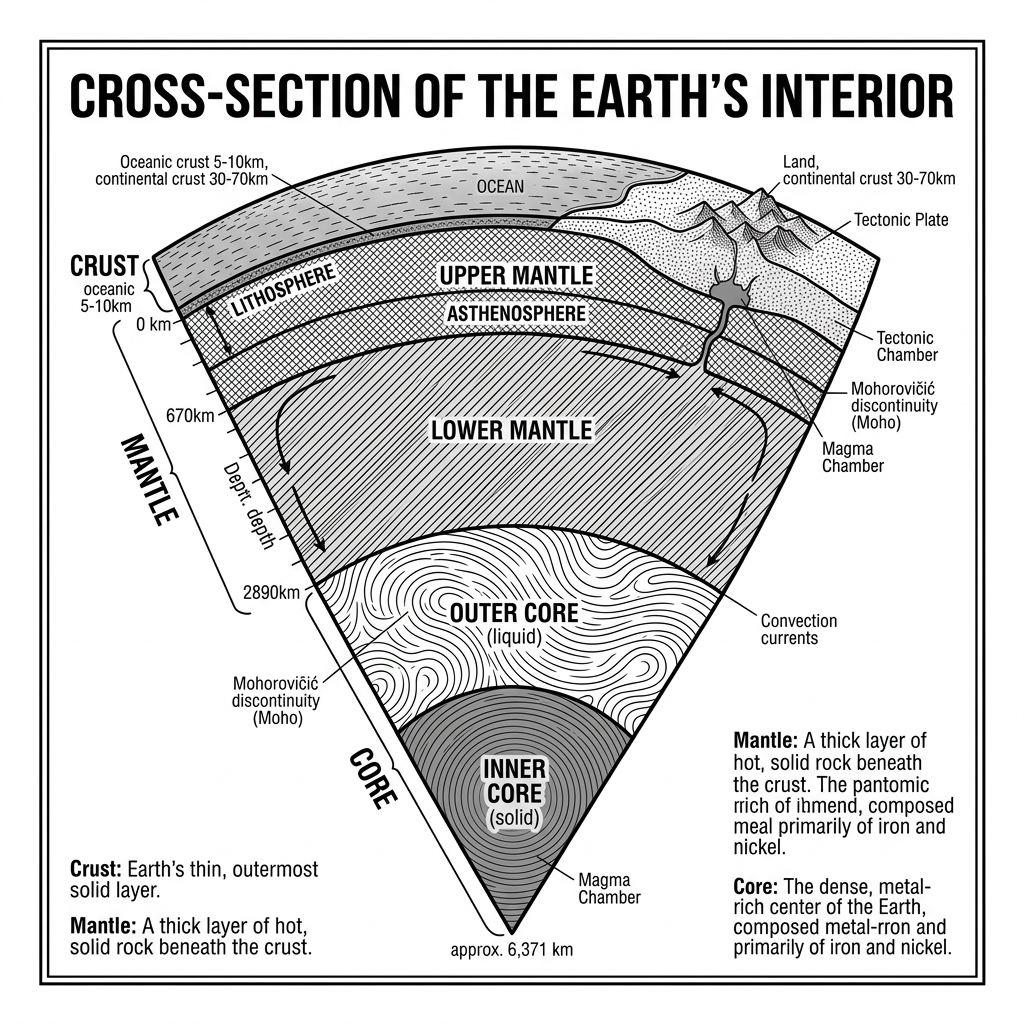
Click an option to check your answer and see why.
Click an option to check your answer.